Concept on Dignified Menstruation
Dignified Menstruation Friendly Indicators
For Knowledge Platforms, Advocacy, and Institutional Practice of GSCDM
1. Introduction
Menstrual discrimination refers to the taboos, shame, stigma, restrictions, abuse, violence, and lack of access to resources and services that menstruators face throughout their lives. It affects people of all ages, backgrounds, abilities, and identities. This discrimination is a form of sexual and gender-based violence and a violation of human rights. It exists across cultures and countries in different forms and intensities, and it plays a significant role in reinforcing inequality, power imbalances, and patriarchal systems.
In response to these challenges, the concept of Dignified Menstruation (DM) was developed as a holistic and life-cycle approach to addressing all forms of menstrual discrimination. Coined and officially defined by GSCDM/RPF in 2019, dignified menstruation refers to a state in which individuals are free from silence, stigma, shame, abuse, restrictions, violence, and deprivation related to menstruation. It emphasizes respect, equity, safety, and access to resources and services for all menstruators in their diversity.
Dignified menstruation recognizes that menstruation is not only a health issue, but also a matter of human rights, social justice, environmental sustainability, and institutional responsibility. It encompasses access to appropriate products, safe and supportive environments, accurate information, and accountable systems. By addressing both structural and social barriers, dignified menstruation offers a comprehensive approach to ending menstrual discrimination.
GSCDM has been at the forefront of advancing the dignified menstruation movement globally through research, advocacy, policy engagement, and community-based action. Over the years, GSCDM has contributed to building global awareness, strengthening networks, and promoting evidence-based solutions that center the voices and experiences of menstruators. While global momentum around menstrual health and dignity is growing, it is equally important to translate shared learning, principles, and commitments into practical action. Policies, programs, and institutions need clear guidance on how to implement dignified menstruation in real-life settings. This is where the Dignified Menstruation Indicators play a vital role.
This guiding narrative framework presents GSCDM’s integrated approach to promoting dignified menstruation through practical indicators and narrative guidance. It is designed to support policymakers, educators, employers, community leaders, and development partners in transforming values into measurable actions. The framework moves beyond infrastructure and service delivery to address social norms, equity, sustainability, and institutional accountability, ensuring that dignified menstruation becomes a lived reality for all.
2. The 3Ps Model: Indicators for Dignified Menstrual Products
(Person, Planet, Pocket)
The 3Ps Model ensures that menstrual products uphold personal dignity, environmental responsibility, and economic accessibility.
2.1 Person: Centering Menstruators in All Their Diversity
Principle
All menstruators have the right to manage menstruation safely, confidently, and without discrimination, regardless of age, disability, -Inches-(90-×-50-cm)-1781843740.png) caste, class, gender identity, migration status, or location.
caste, class, gender identity, migration status, or location.
Key Indicators
- Right to choice on menstrual products
- Access to accurate and unbiased information on all menstrual products
- Freedom from stigma and discrimination
Dignified menstruation begins with respecting individual choice and bodily autonomy. Menstruators must be empowered to select products that suit their health needs, comfort, cultural context, and lifestyle. Institutions must ensure access to comprehensive, evidence-based information on all available options, including reusable and disposable products.
Discriminatory practices, myths, and restrictions related to menstruation undermine dignity and participation. Communities and institutions must actively challenge harmful norms and promote respect.
Illustrative Practice
Schools and community centers provide inclusive education sessions on various menstrual products. Students and participants are supported to make informed choices without judgment or coercion.
2.2 Planet: Environmental Responsibility
Principle
Menstrual management systems must minimize environmental harm and promote sustainable practices.
Key Indicators
- Plastic-free materials
- Chemical-safe production
- No burden to air, soil, water, and the entire planet
Many conventional menstrual products contribute significantly to plastic waste and chemical contamination. Dignified menstruation requires a transition toward biodegradable, reusable, and recyclable alternatives.
Manufacturers, users, governments, and service providers share responsibility for promoting sustainable production, use, and disposal practices. Environmental education must accompany product distribution.
Illustrative Practice
Local governments and civil society organizations support biodegradable pad production and establish safe disposal and composting systems. Schools integrate environmental awareness into menstrual education.
2.3 Pocket: Affordability and Accessibility
Principle
Cost must never prevent access to safe menstrual products.
Key Indicators
- Affordable pricing
- Quality assurance
- Availability: locally produced
Menstrual products are essential health commodities, not luxury items. Economic barriers disproportionately affect marginalized populations and reinforce gender inequality.
Affordable, locally produced products can improve access while supporting community livelihoods. Public financing mechanisms, social enterprises, and subsidy programs play a vital role.
Illustrative Practice
Women-led cooperatives manufacture and distribute quality reusable pads at low cost in rural and urban markets.
3. The 4S Framework: Indicators for Dignified Menstruation-Friendly WASH Facilities
(Safety, Security, Save, Stigma-Free)
The 4S Framework ensures that water, sanitation, and hygiene facilities support dignity, privacy, and health.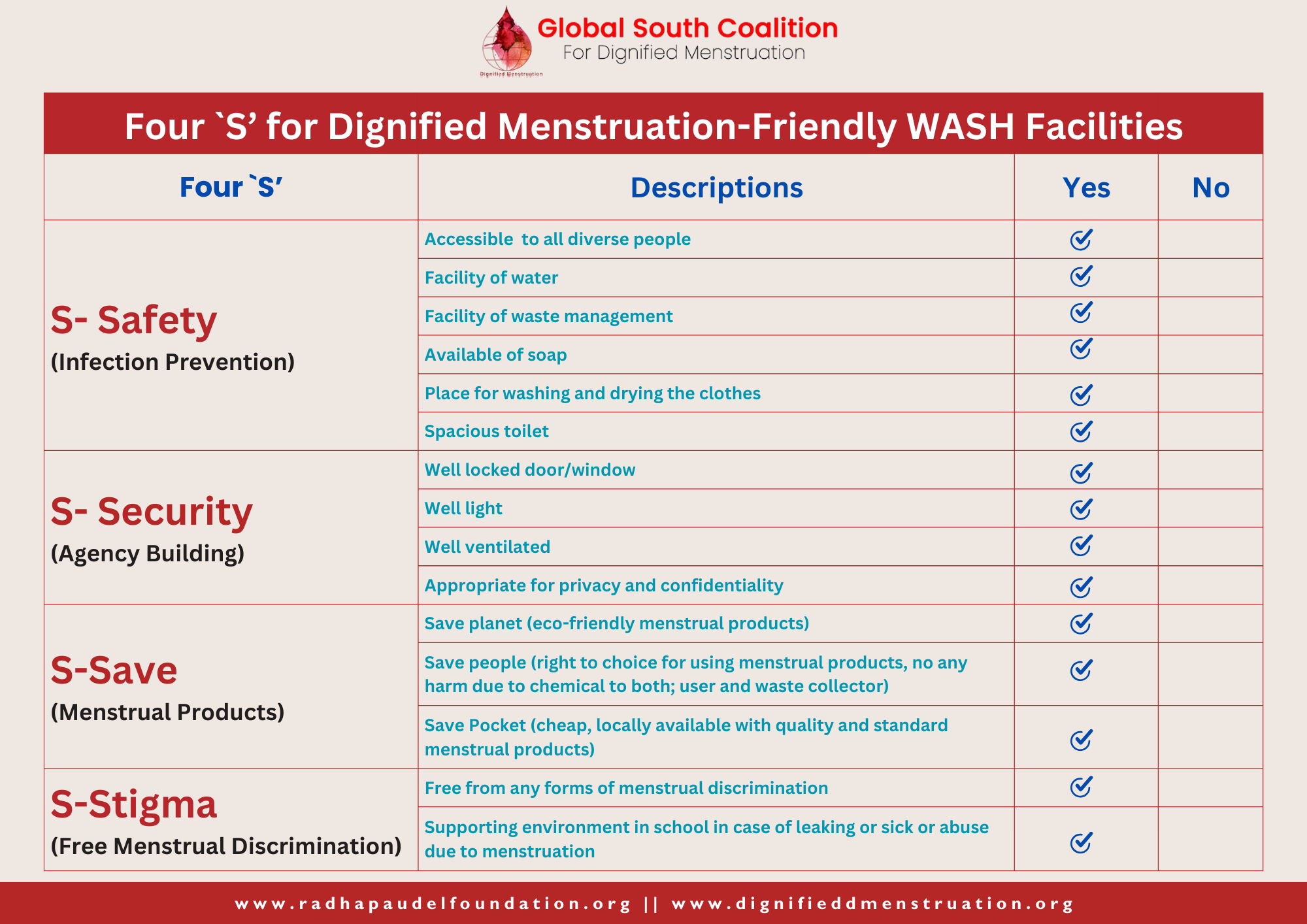
3.1 Safety: Infection Prevention
Key Indicators
- Accessible to all, including a diverse population
- Clean water supply
- Soap availability
- Facility of waste management
- Place for washing and drying clothes
- Spacious and functional toilets
Safe facilities are essential for menstrual management. Without water, soap, and appropriate disposal systems, menstruators face increased health risks.
Facilities must support both disposable and reusable products through adequate washing, drying, and waste management infrastructure.
Illustrative Practice
School toilets are equipped with running water, soap, covered bins, and private washing areas with access to sunlight for drying reusable materials.
3.2 Security: Agency Building
Key Indicators
- Lockable doors and windows
- Adequate lighting
- Adequate ventilation
- Visual and auditory privacy and confidentiality
Fear of harassment, exposure, or violence limits access to sanitation facilities. Secure and private spaces enhance autonomy, confidence, and well-being.
Infrastructure design must prioritize the safety and emotional comfort of all users.
Illustrative Practice
Workplaces install gender-sensitive toilets with internal locks, lighting, and ventilation for safe use at all hours.
3.3 Save: Menstrual Products
Key Indicators
- Save the planet (availability of eco-friendly products)
- Save people (right to choose products that are made of safe, chemical-free materials, with no known health risk to the user and waste collector)
- Save pocket (affordable, locally available products with good quality and standards)
WASH facilities should enable sustainable menstrual practices through storage, information, and appropriate disposal systems. They should promote health, environmental responsibility, and cost-effectiveness simultaneously.
Illustrative Practice
Universities provide reusable products through vending systems and display instructions for safe use and maintenance.
3.4 Stigma: Free from Menstrual Discrimination
Key Indicators
- Free from any forms of menstrual discrimination
- Supporting environment in school during leaks, illness or abuse relating to menstruation
Narrative Guidance
Infrastructure alone cannot ensure dignity. Social environments must be rooted in empathy, understanding, and respect. Institutions must respond compassionately to menstruation-related challenges.
Clear policies and staff training are essential to prevent humiliation and exclusion.
Illustrative Practice
Schools allow flexible attendance for students experiencing pain and train teachers in sensitive response mechanisms.
4. The 4D Framework: Indicators for Dignified Menstruation-Friendly Workplace and Menstrual Leave
(Define, Dismantle, Detect, Declare)
The 4D Framework guides organizations in institutionalizing menstrual dignity and inclusion. 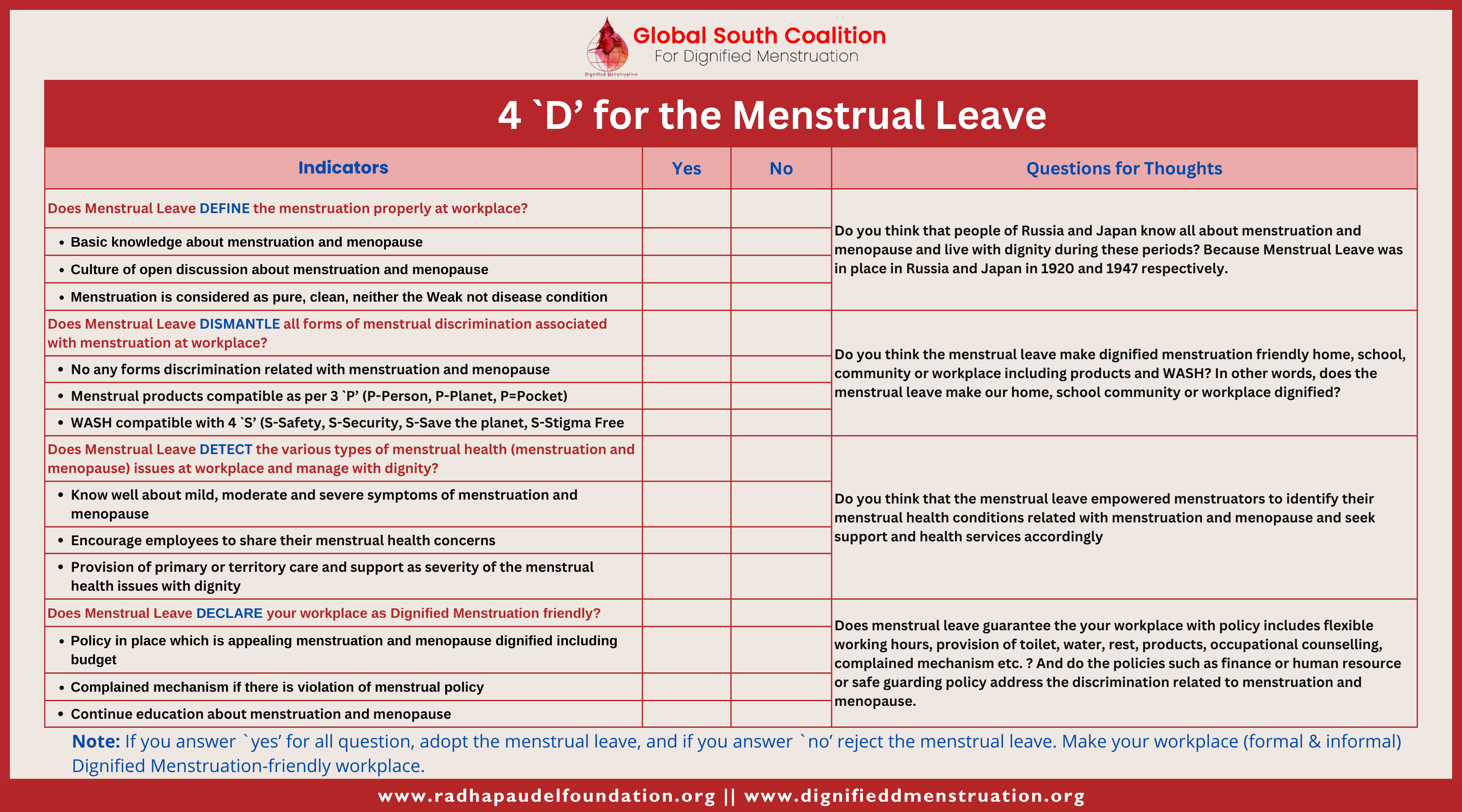
4.1 Define: Knowledge and Awareness
Key Indicators
- Basic knowledge about menstruation and menopause
- Culture of open discussion about menstruation and menopause
- Menstruation is considered pure and clean, and not weak nor a diseased condition
Workplaces must promote an accurate understanding of menstruation and menopause. Regular education initiatives reduce misinformation and normalize biological processes.
Illustrative Practice
Organizations conduct annual awareness sessions for all employees, including management and male staff.
4.2 Dismantle: Eliminating Discrimination
Key Indicators
- No forms of discrimination related to menstruation and menopause
- Menstrual products are compatible as per the 3 ‘P’ approach (Person, Planet, Pocket)
- WASH is compatible with the 4 ‘S’ approach (Safety, Security, Save the planet, Stigma free)
Menstrual policies must not reinforce stigma or penalize employees. Leave and support systems must protect confidentiality and career progression.
Illustrative Practice
Menstrual leave is managed discreetly and excluded from performance evaluations.
4.3 Detect: Identifying Health Needs
Key Indicators
- Know well about mild, moderate, and severe symptoms of menstruation and menopause
- Encourage employees to share their menstrual health concerns
- Provision of primary or territory care and support as severity of the menstrual health issues with dignity
Organizations should support early identification and management of menstrual and menopausal health conditions. Referral systems and accommodations are essential.
Illustrative Practice
Offices partner with health providers for consultation and referral services.
4.4 Declare: Institutional Commitment
Key Indicators
- Policy in place that is appealing to menstruation and menopause, dignified, including a budget
- A complaint mechanism if there is a violation of the menstrual policy
- Continue education about menstruation and menopause
Formal policies, budgets, and accountability mechanisms demonstrate organizational responsibility.
Illustrative Practice
Companies integrate menstrual health into HR policies, allocate budgets for facilities, and establish grievance mechanisms. If the answer to all key indicators is “Yes”, adopt a menstrual leave policy. If the answer is “No”, reject the menstrual leave policy.
5. Indicators for Dignified Menstruation-Friendly Schools and Educational Institutions
Schools play a central role in shaping lifelong attitudes and behaviors related to menstruation.
Key Indicator:
- In school/ educational organization, there is an open discussion on menstruation among students, teachers, student-teachers, school- school management committee.
- There should be a poster stating "Welcome to Dignified Menstruation-friendly school" at the entrance of the school.
- Schools should display quotes related to Dignified menstruation, such as "Menstrual blood is clean and pure blood,", "This world exists because of menstrual blood", and "We all are born from menstrual blood" on school walls.
- In offices, classrooms, and other rooms, there should be posters about menstrual products, including their advantages and disadvantages, and discussions should be encouraged.
- Schools should have a complaint mechanism and a reward system for those who follow DM-friendly practices.
- Schools should allocate a budget for discussions and programs on Dignified Menstruation.
- Schools should have separate toilets for menstruators and non-menstruators. Menstruators’ toilets should have a secure door, lockable windows, sufficient water, water buckets, hooks for hanging handbags, and dustbins or other facilities for disposing of used menstrual products.
- Menstrual products should be environment friendly, safe for users, and of good quality (3P model).
- Schools should be Dignified Menstruation-friendly (flexible leave policies, rest rooms, systems to address menstrual health issues, and allocated budgets).
- Schools should include content on menstruation and menopause from Grade 1 to Grade 10.
Dignified menstruation-friendly schools promote openness, accurate education, supportive infrastructure, and institutional accountability. Menstruation is treated as a normal biological process rather than a source of shame.
Schools must integrate menstrual health into curricula, allocate resources, and foster inclusive cultures.
Illustrative Practice
A school integrates age-appropriate lessons on menstruation and menopause into health and life-skills curricula from Grade 1 to Grade 10. Teachers are trained to deliver the content in a sensitive and inclusive manner, using interactive methods, visual materials, and open discussions. Regular sessions are organized for students and parents to reinforce learning at home. Educational materials are reviewed periodically to ensure accuracy, cultural relevance, and alignment with dignified menstruation principles.
-1726033997.png)